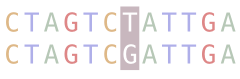
LongevityMap variant
Entry Details
- Longevity Association
- Non-significant
- Population
- Italian (Southern)
- Study Design
- A two-stage case-control study was performed to identify the association between longevity and variation of in homeostasis regulation pathway genes. 317 SNPs in 104 genes were analyzed in 78 cases (≥90 years, median age 98 years, 42 females) and 71 controls (<90 years, median age 67 years, 32 females) in stage 1. Then, 31 candidate SNPs identified in stage 1 (π markers = 0.1) were analyzed in an independent sample composed by 288 cases (≥90 years, median age 92 years, 163 females) and 554 controls (<90 years, median age 67 years, 277 females).
- Conclusions
- After adjustment for multiple testing, no significant association was identified between various SNPs and longevity.
- Identifier
- rs2494732
- In Other Studies (IDs)
- 1274
- Cytogenetic Location
- 14q32.33
- UCSC Genome Browser
- View 14q32.33 on the UCSC genome browser
Gene details
- HGNC symbol
- AKT1
- Aliases
- AKT; PKB; RAC; CWS6; PRKBA; PKB-ALPHA; RAC-ALPHA
- Common name
- AKT serine/threonine kinase 1
- Description
- The serine-threonine protein kinase encoded by the AKT1 gene is catalytically inactive in serum-starved primary and immortalized fibroblasts. AKT1 and the related AKT2 are activated by platelet-derived growth factor. The activation is rapid and specific, and it is abrogated by mutations in the pleckstrin homology domain of AKT1. It was shown that the activation occurs through phosphatidylinositol 3-kinase. In the developing nervous system AKT is a critical mediator of growth factor-induced neuronal survival. Survival factors can suppress apoptosis in a transcription-independent manner by activating the serine/threonine kinase AKT1, which then phosphorylates and inactivates components of the apoptotic machinery. Mutations in this gene have been associated with the Proteus syndrome. Multiple alternatively spliced transcript variants have been found for this gene. [provided by RefSeq, Jul 2011]
- Other longevity studies of this gene
- 9
- OMIM
- 164730
- Ensembl
- ENSG00000142208
- UniProt/Swiss-Prot
- AKT1_HUMAN
- Entrez Gene
- 207
- UniGene
- 525622
- HapMap
- View on HapMap