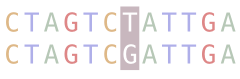
LongevityMap variant
Entry Details
- Longevity Association
- Non-significant
- Population
- Italian (Southern)
- Study Design
- A two-stage case-control study was performed to identify the association between longevity and variation of in homeostasis regulation pathway genes. 317 SNPs in 104 genes were analyzed in 78 cases (≥90 years, median age 98 years, 42 females) and 71 controls (<90 years, median age 67 years, 32 females) in stage 1. Then, 31 candidate SNPs identified in stage 1 (π markers = 0.1) were analyzed in an independent sample composed by 288 cases (≥90 years, median age 92 years, 163 females) and 554 controls (<90 years, median age 67 years, 277 females).
- Conclusions
- After adjustment for multiple testing, no significant association was identified between various SNPs and longevity.
- Identifier
- rs4803455
- In Other Studies (IDs)
- 1543
- Cytogenetic Location
- 19q13.2
- UCSC Genome Browser
- View 19q13.2 on the UCSC genome browser
Gene details
- HGNC symbol
- TGFB1
- Aliases
- CED; LAP; DPD1; TGFB; TGFbeta
- Common name
- transforming growth factor beta 1
- Description
- This gene encodes a secreted ligand of the TGF-beta (transforming growth factor-beta) superfamily of proteins. Ligands of this family bind various TGF-beta receptors leading to recruitment and activation of SMAD family transcription factors that regulate gene expression. The encoded preproprotein is proteolytically processed to generate a latency-associated peptide (LAP) and a mature peptide, and is found in either a latent form composed of a mature peptide homodimer, a LAP homodimer, and a latent TGF-beta binding protein, or in an active form consisting solely of the mature peptide homodimer. The mature peptide may also form heterodimers with other TGFB family members. This encoded protein regulates cell proliferation, differentiation and growth, and can modulate expression and activation of other growth factors including interferon gamma and tumor necrosis factor alpha. This gene is frequently upregulated in tumor cells, and mutations in this gene result in Camurati-Engelmann disease. [provided by RefSeq, Aug 2016]
- Other longevity studies of this gene
- 17
- OMIM
- 190180
- Ensembl
- ENSG00000105329
- UniProt/Swiss-Prot
- TGFB1_HUMAN
- Entrez Gene
- 7040
- UniGene
- 645227
- HapMap
- View on HapMap
Homologs in model organisms
In other databases
- GenAge human genes
- This gene is present as TGFB1